
close menu
Why the UK needs more welders, and why energy is driving demand
A skill the energy transition cannot do without
The UK is in the middle of the largest build programme its energy system has seen in a generation. Offshore wind farms are growing in size and number, new nuclear capacity is under construction, carbon capture clusters are moving forward and the electricity grid is being upgraded to carry it all.
Each of these depends on welding. Wind turbine foundations, transition pieces and towers are fabricated from heavy steel plate joined by welders. Nuclear reactor buildings and their pipework require welds of exceptional quality, inspected to strict standards. Carbon capture schemes need pipelines and process plant. Substations, interconnectors and network upgrades all need steel structures and fabricated components.
Without enough qualified welders, the projects slow down.
What the evidence says
In October 2025 the government published the Clean Energy Jobs Plan, the first national plan for the clean energy workforce. It sets out an expected 400,000 additional jobs across clean energy by 2030, and names 31 priority occupations that are particularly in demand. Welders are among them.
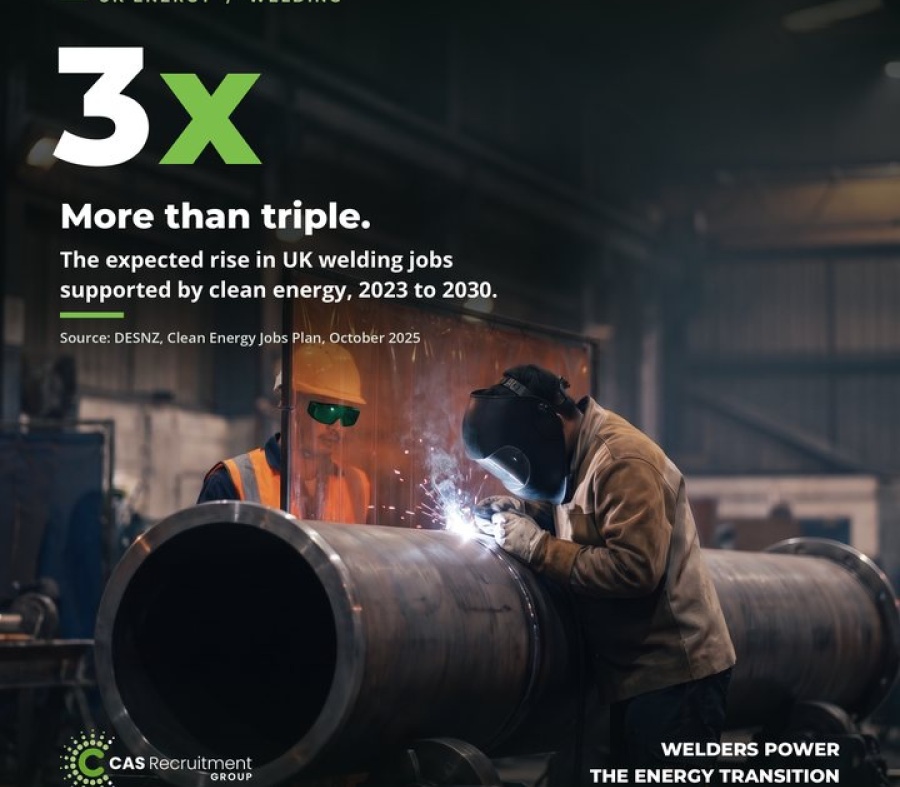
The plan's own figures show that the number of welding jobs supported by clean energy industries is expected to more than triple between 2023 and 2030.
That growth is landing on a workforce that is already stretched. In its July 2026 review, the Migration Advisory Committee found that the quantitative evidence for welding trades showed a shortage, and treated welding as a stronger case for temporary shortage treatment. Skills England's 2026 assessment also identifies welding as a priority occupation across several sectors, not energy alone.
Where the demand is coming from
Offshore wind. The UK's offshore wind pipeline is large and still growing. Foundations, towers and the steel structures that support them require large volumes of structural and heavy plate welding, much of it carried out in fabrication yards and ports.
Nuclear. Hinkley Point C is under construction in Somerset, and Sizewell C in Suffolk is expected to support 10,000 jobs at peak construction. Nuclear projects need welders who can work to the highest standards of quality and documentation, and specialist nuclear grade welders are in particularly short supply.
Carbon capture and storage. The Acorn and Viking carbon capture projects are estimated to support a combined 35,000 jobs. Pipelines, compression plant and storage infrastructure all require skilled pipe welders.
The grid. Network operators are expanding and reinforcing the electricity network to connect new generation. That work needs steel fabrication for substations, towers and supporting structures.
Oil and gas, and the wider economy. Existing energy infrastructure still needs maintenance and modification, while advanced manufacturing, defence, construction and shipbuilding compete for the same welders.
Why the gap will not close on its own
Training a competent welder takes time, and coding to the standards energy projects demand takes longer. New apprenticeship routes are welcome, including a publicly funded Level 2 mechanised welding unit approved in 2026, but new entrants cannot replace experienced, coded welders overnight.
At the same time, many experienced welders are approaching retirement, and energy projects compete with every other industry that relies on fabrication. The result is a market in which skilled welders have more choice than ever, and employers who wait until a project starts may struggle to staff it.
What this means for employers
Plan early. Map your welding requirement against your project timeline, including the processes, positions and codes you need, and start recruiting before the work begins.
Look wider. The UK workforce alone will not meet demand. Experienced welders already in the UK, and skilled welders from overseas recruited through a properly managed, ethical process, can close the gap.
Test before you hire. Trade testing against the specific processes and standards your work requires reduces risk and protects quality.
What this means for welders
For skilled welders, the outlook is strong. Energy projects offer long term work, the chance to build experience on nationally important infrastructure, and pay that reflects the skill involved. The Clean Energy Jobs Plan notes that jobs in wind, nuclear and electricity networks advertise average salaries above the UK average.
Welders who hold current coding, can work across MIG, TIG, MAG and MMA processes, and are willing to move to where the projects are will be in demand for years to come.
How CAS Recruitment can help
CAS Recruitment places skilled trades talent, including welders and fabricators, with employers across the UK and Ireland. We source experienced candidates in the UK and overseas, trade test them before employers see a profile, and manage the process through to arrival on site. Workers are never charged fees, at any stage.
If welding capacity is holding back your plans, or you are a welder looking for your next role in the energy sector, get in touch with our team today.
Sources
- Department for Energy Security and Net Zero, Clean energy jobs boom to bring thousands of new jobs, 19 October 2025: https://www.gov.uk/government/news/clean-energy-jobs-boom-to-bring-thousands-of-new-jobs
- Clean Energy Jobs Plan: https://www.gov.uk/government/publications/clean-energy-jobs-plan
- Plant and Works Engineering, UK faces critical welder shortage as government confirms clear shortfall, 22 October 2026 (reporting the Migration Advisory Committee July 2026 review and Skills England 2026 assessment): https://pwemag.co.uk/uk-faces-critical-welder-shortage-as-government-confirms-clear-shortfall/
- Enginuity, Skills Insight: Welding Week 2026: https://enginuity.org/news-and-views/skills-insight-engineering-and-manufacturing-unpacked-welding-week-2026