
close menu
The Workforce Shortfall
Walk onto a meat processing line in Yorkshire, a building site in Dublin, a fabrication shop in the Midlands or a dairy farm in Munster, and you'll hear different accents, different machinery, different problems. But ask the operations manager the same question, "what's keeping you up at night?", and you'll get the same answer.
People. Or rather, the lack of them.
This is no longer a recovery story from the pandemic, or a Brexit aftershock, or a one-off seasonal blip. The labour shortage running through Britain and Ireland's skilled trades has settled into something harder to fix: a structural, demographic, multi-sector workforce gap that domestic recruitment and training, alone, cannot close in the time the economy actually has.
Here's what the picture looks like on the ground, sector by sector, in 2026.
Food processing and meat: the supply chain's quiet emergency
UK food and drink manufacturing employs around four million people across the wider supply chain, and it has been short of workers for years. Skilled butchers and meat processors remain among the hardest roles in the country to fill. Historically, more than 60% of the UK meat sector's workforce was sourced from outside the UK, and that pipeline has not been replaced. The Food and Drink Federation has tracked persistent vacancy rates well above the cross-economy average since 2022, with shortages stretching from production operatives through to engineers and technical specialists.
In January 2026, a major industry report from Arla Foods and Harper Adams University put it bluntly: labour and skills shortages now pose a risk to UK food security itself. That's not a recruitment problem. That's a strategic vulnerability.
Agriculture: the seasonal scheme that doesn't scale to year-round work
Agriculture has the same demographic problem as the rest of the food chain, complicated by seasonality. The Seasonal Worker Scheme has kept fruit, vegetable and horticultural production limping along, but it doesn't address the year-round skilled roles (herd managers, agricultural mechanics, agri-engineers) that keep farms operational outside of peak picking.
In Ireland, the picture is sharper. Ireland's May 2026 employment-permit reforms specifically added agri-food roles to the eligible occupations list, alongside construction, healthcare and transport, a clear signal from Dublin that the agri-food workforce is now a stated national priority.
Welding and fabrication: the most exposed sector
If you want to see what a workforce crisis looks like with the numbers stripped of euphemism, look at welding.
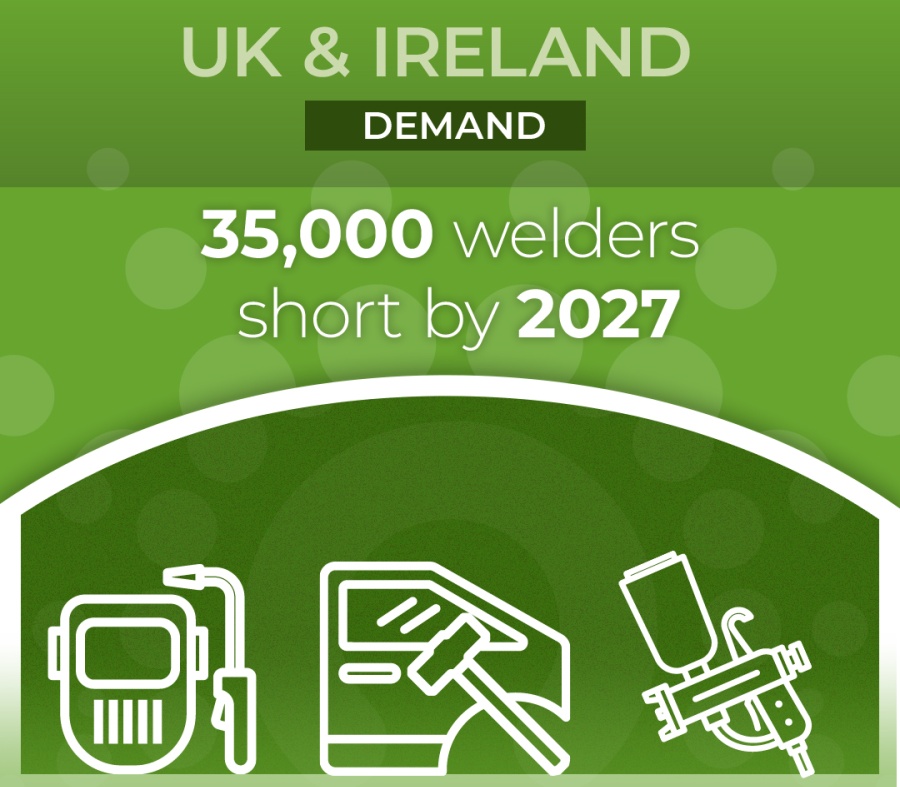
The average age of a UK welder is around 55. WorldSkills UK estimates the country will be short of more than 35,000 skilled welders by 2027. Apprenticeship starts in welding fell by 45% between 2015 and 2024, meaning the pipeline shrank during the exact decade demand was rising. The UK's 2025 Industrial Strategy Green Paper formally acknowledged the shortage in welding, electrical and mechanical trades; industry leaders responded that the proposed measures fall well short of the scale required.
What welders actually build (steel structures, pressure vessels, wind tower sections, defence platforms, hydrogen and renewable energy infrastructure) is exactly the work the UK has committed to delivering through the 2030s. Without welders, none of it happens. There is no software workaround for a coded weld.
Construction: the housing target nobody can hit without workers
The Construction Industry Training Board's Workforce Outlook for 2025-2029 estimates the UK needs an additional 47,860 construction workers every year, around 239,300 over the next five years, just to meet baseline demand. CITB's Industry Picture 2026 goes further, projecting around 110,000 additional workers per year required by 2030 to hit housing and retrofit targets.
The current government plan to recruit and train 60,000 construction workers by 2029 is, by CITB's own arithmetic, less than a quarter of what's actually needed.
The demographic squeeze underneath those numbers is brutal. Around 35% of UK construction workers are over 50. By 2036, more than 750,000 are projected to retire. Only 15% of the workforce is female and 6% from ethnic minorities, meaning the structural talent pool the industry has historically recruited from is both shrinking and ageing at the same time.
Ireland faces a near-identical shape of problem on a smaller scale: the construction sector needs around 50,000 additional workers by 2030 to deliver the 300,000 homes promised under the Housing for All plan. ManpowerGroup's 2025 Global Talent Shortage Survey found that 76% of Irish employers report difficulty filling roles, among the highest rates in Europe.
Mechanics and skilled trades: engineering's hidden bottleneck
EngineeringUK estimates the country needs more than 173,000 new engineers and technicians every year through 2030. Engineering occupations are projected to grow 2.8% by 2030, slightly outpacing the overall economy, but Make UK research finds that 36% of manufacturing vacancies are hard to fill due to candidates lacking the right skills, far above the 24% average across all industries.
Apprenticeship starts in manufacturing and engineering sat at around 46,070 in the most recent figures, still below the 52,000 recorded before the pandemic. The bench, in other words, is shrinking even as the game gets bigger.
The demographic truth the data keeps pointing to
Across all five sectors, the same shape of problem keeps appearing: an ageing core workforce, a collapsed apprenticeship pipeline, retirement waves arriving faster than new entrants, and demand rising as the country tries to build, decarbonise and re-shore at the same time.
Domestic training and apprenticeships are essential, and the long-term answer cannot be anything else. But here's the uncomfortable arithmetic: even if the UK doubled apprenticeship starts in welding tomorrow, the first cohort of fully qualified coded welders would not be on a fabrication shop floor for three to four years. The retirements happening this year cannot be replaced by people who haven't started training yet.
The same is true in Ireland, in agri-food, in construction, in mechanics. Training is a fifteen-year answer to a five-year problem.
Ethical international recruitment, properly done
This is where international workforce solutions stop being a "nice to have" and start being a structural part of how the UK and Ireland keep building, feeding and manufacturing.
Both countries already accept this in policy. The UK's Skilled Worker visa route, the Health and Care Worker route, and the Seasonal Worker Scheme are all recognitions that the domestic labour market cannot meet demand alone. Ireland's Critical Skills Occupations List and General Employment Permit system play the same role, with the May 2026 reforms expanding the list specifically to ease shortages in construction, healthcare, transport and agri-food.
The question employers face is not whether to access international talent. The question is how, and how ethically.
The skilled migrant workforce is not a commodity. Filipino welders, butchers, agricultural workers and construction tradespeople are not a stopgap; they are professionals with qualifications, families, and decisions to make about where in the world to build a career. The countries and the employers that treat them that way will win the workforce. The ones that don't will keep losing tenders, missing housing targets, and watching production lines slow down.
That means working only with licensed source-country partners, paying proper rates, providing genuine career progression, and, critically, supporting workers when their circumstances change.
The retention problem nobody is talking about
Here's the part of the conversation that often gets missed: bringing a skilled worker into the UK or Ireland is only half the job. Keeping them is the other half, and the system often makes that needlessly hard.
A skilled worker tied tightly to a single employer, with limited mobility and complex visa renewal pathways, is a worker at risk of leaving the country at the first friction point. That's lost training investment, lost continuity on site or on the line, and lost goodwill. A worker who can transition between compliant employers, extend their work authorisation cleanly, and build a long-term life in their destination country is a worker who stays, and who tells five friends back home that the UK or Ireland is a place worth building a career in.
In-country mobility and visa extension support is not a soft benefit. It's a workforce retention strategy. And it is precisely the kind of support CAS Recruitment has built into its operating model from the outset.
What employers and policymakers should actually do
For employers: stop treating international recruitment as the emergency option you call when domestic hiring has failed. Build it into your workforce plan from the start, choose partners who can demonstrate licensed source-country relationships, and invest in retention from day one rather than treating new arrivals as transactional.
For policymakers: keep the legal routes broad enough to match the structural shortage, not narrow enough to pretend it doesn't exist. The Irish 2026 reforms, adding agri-food, construction and transport roles to eligible occupation lists, are exactly the right direction. The UK's Industrial Strategy needs to follow with comparable scope.
For everyone: be honest about the timescale. Apprenticeships are a generation-long answer. The shortages are happening now. Both routes have to run in parallel, or the targets don't get hit.
The workforce shortfall is real. The data has been telling us about it for years. The question now is whether the businesses and the countries that depend on these sectors are going to do something about it, or wait until the food doesn't arrive, the homes aren't built, and the welds aren't there to hold the country together.
CAS Recruitment exists for the businesses that aren't waiting.